 Data River
Which Industries Pay Bookkeepers the Most in Australia in 2026?

By Sandra Vu
Bookkeeping pay in Australia isn't just a function of experience or location — the industry you work in can swing your salary by $5,000 to $15,000 or more. A generalist doing basic transaction processing for a small retail shop earns a very different wage to a bookkeeper managing multi-award payroll for a construction firm or reconciling trust accounts for a law practice.
Below is a breakdown of the sectors and specialisations that consistently command the highest bookkeeper pay in 2026, based on data from SEEK, Scalesuite, and other Australian salary sources.
The national picture
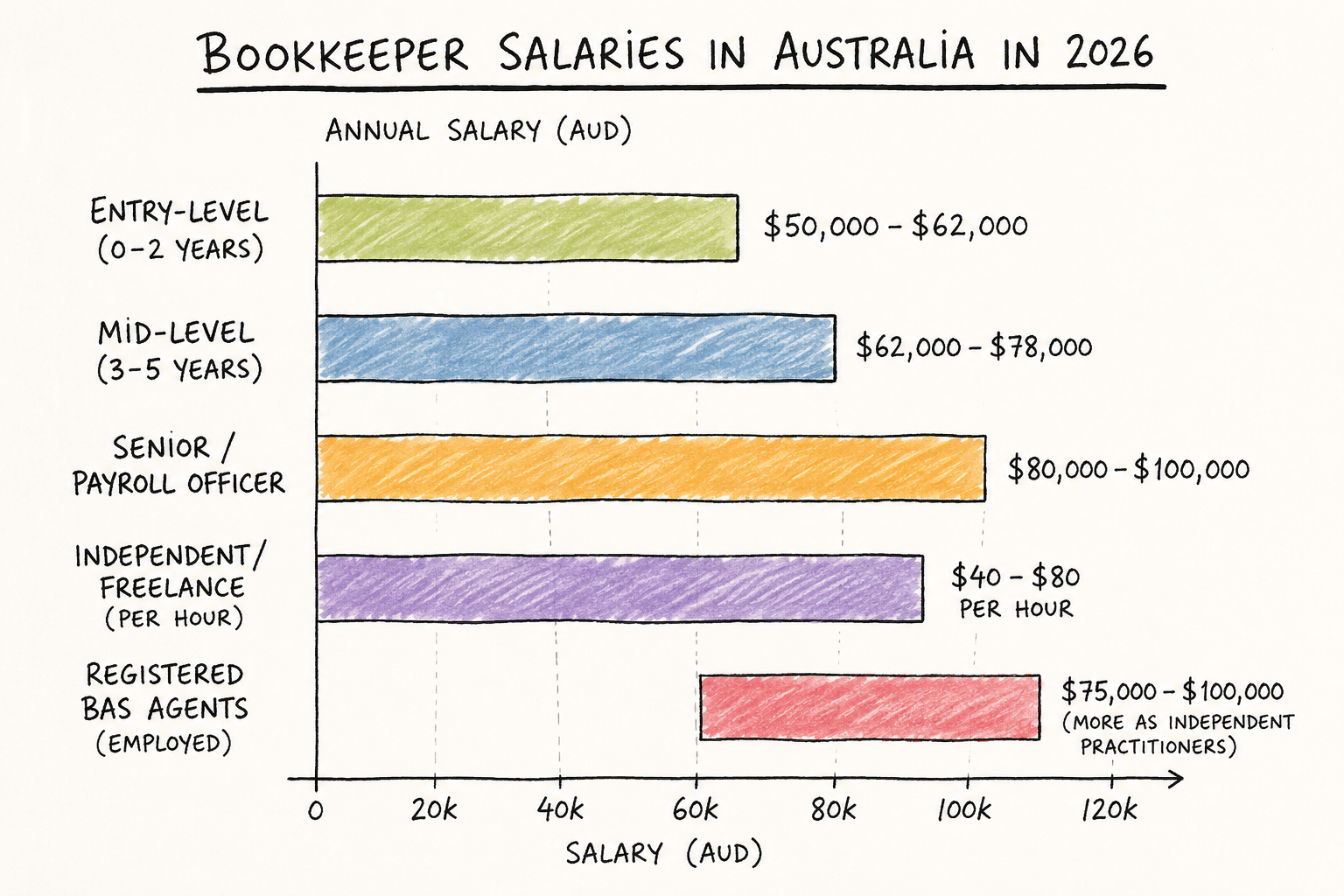
Bookkeeper salaries in Australia in 2026 typically fall into these bands:
- Entry-level (0–2 years): $50,000–$62,000
- Mid-level (3–5 years): $62,000–$78,000
- Senior / Payroll Officer: $80,000–$100,000
- Independent/freelance: $40–$80 per hour, depending on services — see how to think through pricing if you're setting your own rates
- Registered BAS Agents: $75,000–$100,000 employed, more as independent practitioners
SEEK's own data puts the average full-time bookkeeper salary between $75,000 and $90,000, while Indeed and Glassdoor estimates trend a little lower (roughly $68,000–$73,000 average), reflecting the mix of part-time and casual roles included in those figures. The gap between sources is mostly explained by seniority mix and how much of the workforce sampled is full-time versus part-time.
Industries and specialisations that pay a premium
1. Mining and resources Particularly in Western Australia, mining-sector bookkeeping roles can push salaries to Sydney-equivalent levels even outside the major eastern capitals. The complexity of cost tracking across projects and sites is a major driver.
2. Construction and trades Job costing, progress claims, and retention tracking make construction bookkeeping meaningfully more technical than general small-business bookkeeping. Combined with multi-award payroll complexity, this is one of the most consistently well-paid specialisations.
3. Healthcare and medical practices Medicare billing, private health fund reconciliation, and healthcare's award-heavy payroll structures add a premium. Demand here has also been rising faster than in less dynamic sectors.
4. Legal firms Trust accounting is a specialised, tightly regulated skill set, and law firms typically pay above the general bookkeeping market for staff who can handle it competently.
5. SaaS and technology businesses Subscription revenue recognition and reconciling payment platforms like Stripe require a different skill set to standard invoice-based bookkeeping, and tech employers tend to pay accordingly.
6. Hospitality Hospitality's dense web of penalty rates, allowances, and modern awards makes payroll compliance genuinely difficult. Bookkeepers who can handle it reliably are paid a premium over generalists — despite hospitality's reputation as a lower-margin industry overall.
7. Finance and financial services Alongside healthcare and tech, finance is repeatedly flagged as a "high-demand" sector where bookkeeper pay and pay growth outpaces less dynamic industries.
What adds to the premium regardless of industry
A few qualifications and skills add value on top of any industry premium:
- Registered BAS Agent status (with the Tax Practitioners Board) typically adds $5,000–$10,000 over an unregistered bookkeeper doing equivalent work — see what registration actually involves if you're weighing it up.
- Xero or MYOB certification adds roughly a 10–15% premium over self-taught platform users.
- Payroll compliance expertise in award-heavy industries (hospitality, construction, healthcare) adds $5,000–$15,000.
- Reporting capability — producing variance commentary, cashflow updates, and KPI summaries rather than just a monthly P&L — pushes a bookkeeper's role (and pay) closer to a finance officer's.
Location still matters
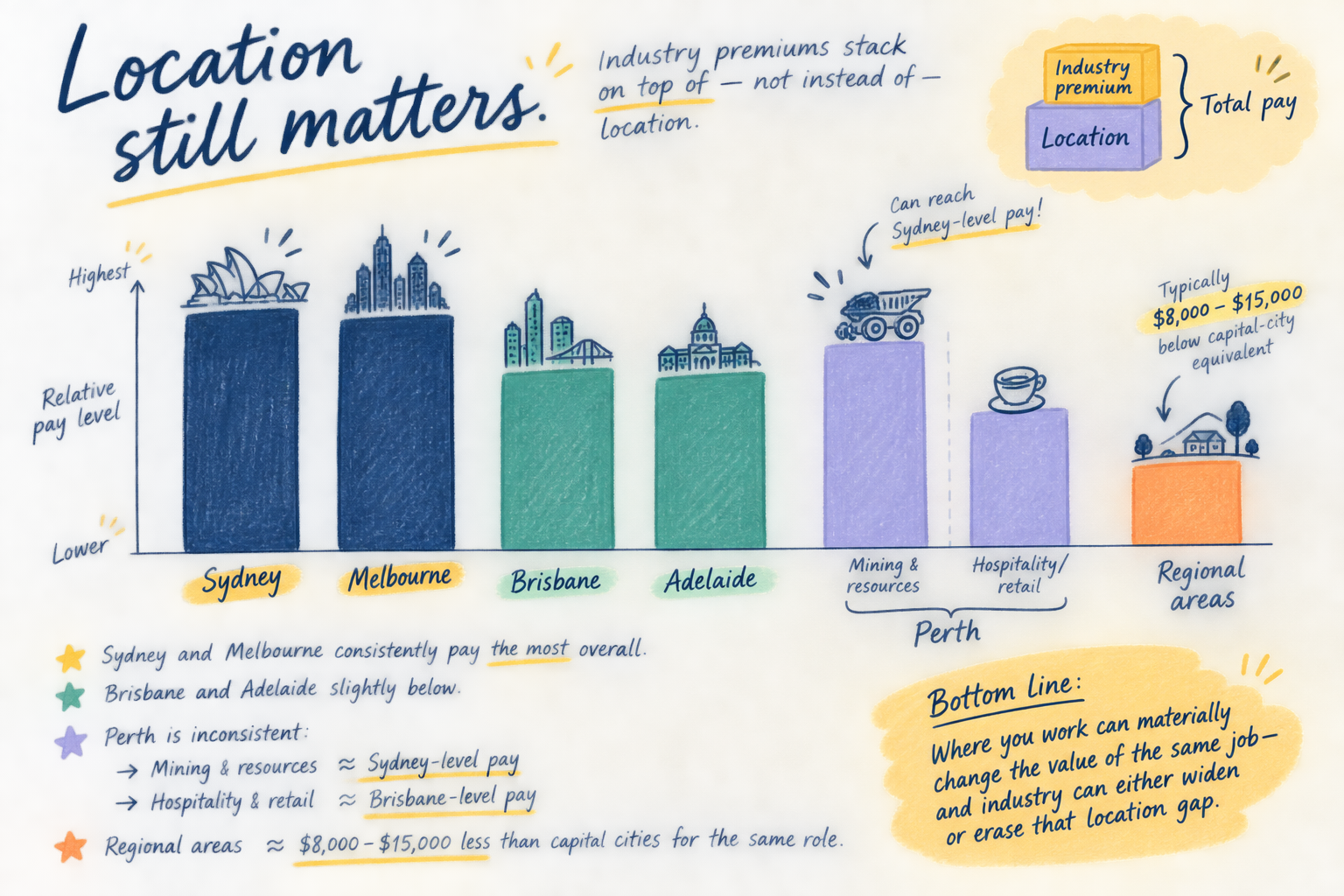
Industry premiums stack on top of — not instead of — location:
- Sydney and Melbourne consistently pay the most overall, with Brisbane and Adelaide slightly below.
- Perth is inconsistent: mining and resources roles can reach Sydney-equivalent pay, while hospitality and retail roles in Perth sit closer to Brisbane rates.
- Regional areas typically pay $8,000–$15,000 below their capital-city equivalent for the same role.
Spend less time on data entry, more time on the work that pays A lot of the "premium" work described above — job costing, trust reconciliation, multi-entity reporting — gets crowded out by the grunt work of manually re-keying bank statement PDFs into Xero or MYOB. Data River converts bank statement PDFs to clean CSV or Excel in seconds, so the hours you'd spend transcribing transactions go toward the higher-value reconciliation and reporting work that actually moves your pay band. Try it free →
The takeaway
If you're a bookkeeper looking to increase your earning potential, the fastest lever isn't necessarily more years of experience — it's specialising. Construction, healthcare, legal trust accounting, and SaaS/tech reconciliation are the areas where demonstrated industry knowledge translates most directly into higher pay, and stacking that with BAS Agent registration or software certification compounds the effect.
If you're a business owner hiring, it's worth budgeting above the general market rate for any role that touches award-heavy payroll, trust accounting, or industry-specific compliance — the scalesuite.com.au guide's rule of thumb of a $5,000–$15,000 premium for payroll compliance expertise is a reasonable starting point for negotiation.
Sources: SEEK Career Advice (Bookkeeper Salary), Scalesuite ("Bookkeeping Salaries in Australia: 2026 Guide"), Indeed, Glassdoor, PayScale, SalaryExpert, SkillsToPivot. Figures current as of mid-2026.
A note on scope: SEEK's industry-by-industry salary breakdown for bookkeepers is presented as an interactive tool on their site rather than a static published ranking, so this article draws on the qualitative industry findings reported across SEEK, Scalesuite, and other sources rather than a numbered top-28 list. If you're after SEEK's live, exact industry-by-industry figures, their career advice page for the Bookkeeper role lets you filter and compare industries directly.

About Sandra Vu
Sandra Vu is the founder of Data River and a financial software engineer with experience building document processing systems for accounting platforms. After spending years helping accountants and bookkeepers at enterprise fintech companies, she built Data River to solve the recurring problem of converting bank statement PDFs to usable data—a task she saw teams struggle with monthly.
Sandra's background in financial software engineering gives her deep insight into how bank statements are structured, why they're difficult to parse programmatically, and what accuracy really means for financial reconciliation. She's particularly focused on the unique challenges of processing statements from different banks, each with their own formatting quirks and layouts.
At Data River, Sandra leads the technical development of AI-powered document processing specifically optimized for financial documents. Her experience spans building parsers for thousands of bank formats, working directly with accounting teams to understand their workflows, and designing systems that prioritize accuracy and data security in financial automation.